Sewage Backup Cleanup in Modesto, CA
A sewage backup is Category 3 the moment it happens. Modesto water damage pros contain it, remove what it touched and treat and dry what stays.
Sewage backing up? Call for cleanup nowOpen 24/7: (888) 774-9605
First steps for sewage backup cleanup in Modesto
Stop using water
Do not flush, shower or run the dishwasher. Every drain adds to the backup.
Keep everyone out
Keep children, pets and anyone with a weak immune system away from the affected area.
Do not clean it yourself
Household cleaners do not handle sewage safely, and mopping spreads it. Close the door to the area if you can.
Photograph and call
Take photos from a safe distance, then call for sewage backup cleanup.
What does sewage backup cleanup cost in Modesto, CA?
In Modesto, CA, sewage backup cleanup typically runs $2,500 to $12,000, depending on how far the sewage spread, how much flooring and drywall must be removed, whether a crawlspace was affected and how much drying follows.
Bathroom only
$2,500 to $4,500- Containment and PPE
- Toilet and floor removal
- Antimicrobial treatment
Several rooms
$4,500 to $8,000- Carpet and drywall removal
- HEPA air scrubbers
- Structural drying
Crawlspace or wide spread
$8,000 to $12,000+- Crawlspace treatment
- Extensive removal
- Full documentation
These are typical ranges, not a quote. The water category, the square footage, the material class and how fast drying started move the number most. Try the water damage cost calculator for a planning range.
What a proper sewage backup cleanup job includes
The order of the work is what separates a finished dry-out from a cosmetic one.
Rapid local response
The response team picks up around the clock and sends the closest available crew with pumps, meters and drying gear.
IICRC S500 drying standard
Moisture mapping comes first, and the equipment stays until the readings match a dry reference, not until the room looks dry.
Claim-ready documentation
Most crews log daily moisture readings and take timestamped photos before anything is torn out, so the file matches the loss.
Central Valley water experts
Slab leaks, crawlspaces, attic air handlers and winter storm water are the everyday losses for Modesto water damage pros.
Sewage in a house is a health problem first and a water problem second. It usually comes up through the lowest drain in the house, often a shower, tub or toilet, when the line to the street is blocked, collapsed or overwhelmed.
Why sewage backs up in Modesto homes
- Tree roots growing into older clay or cast iron sewer laterals in established neighborhoods
- Grease and wipes building up into a blockage in the line to the street
- Sagging or broken laterals under older homes
- Heavy winter storms pushing water into the sewer system
A plumber clears or repairs the line. The restoration crew handles everything the sewage touched.
The Category 3 protocol
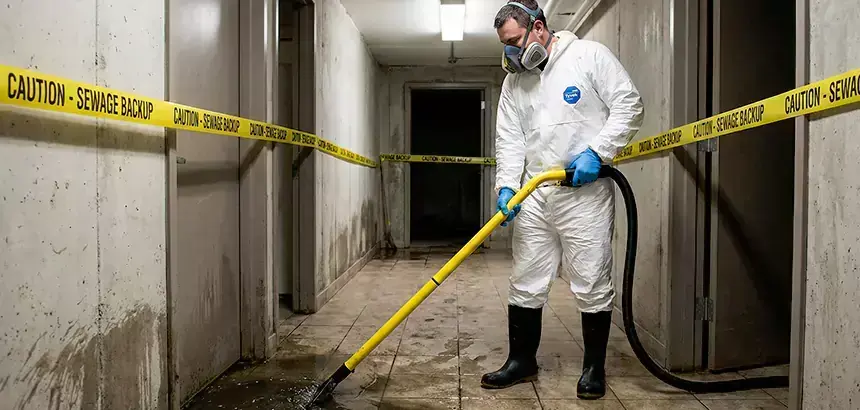
The mitigation team works in protective suits, gloves, boots and respirators, and sets containment with plastic sheeting and HEPA air scrubbers so the rest of the house stays clean. Then:
- Standing sewage is extracted and disposed of properly
- Porous materials the water touched come out: carpet, pad, the bottom of the drywall and insulation
- Hard surfaces are cleaned and treated with an EPA-registered antimicrobial at its labeled dwell time
- The area is dried and checked before rebuilding starts
The EPA list of EPA-registered disinfectants shows what those products are, and OSHA flood cleanup guidance covers the protective gear for contaminated water.
What you can and cannot save
Porous materials touched by Category 3 water get removed, not dried. Solid wood furniture and hard plastics can often be cleaned; upholstered furniture, mattresses and carpet usually cannot. If sewage reached a raised-foundation home's crawlspace, the soil and vapor barrier are treated too. Flood water from outside follows the same rules, covered on the flood water cleanup page.
The trade fact that matters
Sewage backup is Category 3 the moment it happens. There is no waiting period where it counts as clean water, which is why containment and PPE go up before any removal starts.
How sewage backup cleanup is handled in Modesto
- 01
Call and triage
The restoration team asks where the water came from, which rooms are wet and whether it is clean, gray or sewage water, then sends a crew.
- 02
Map the moisture
The tech who does the walkthrough uses a thermal camera and pinless meters to map every wet wall, floor and cavity before any equipment goes down.
- 03
Extract and set drying
The extraction crew pulls standing water, then sets air movers and LGR dehumidifiers to the evaporation load of each room.
- 04
Read daily, then verify dry
Most crews record readings every day and pull equipment only when wet materials sit within 2 to 4 points of a dry reference in the same building.
Covering Modesto and Stanislaus County
The Modesto water damage pros take calls from every Modesto ZIP, from Village One down to the Airport District, plus Ceres, Salida, Riverbank, Empire, Hughson, Oakdale and Turlock.
See every neighborhood and ZIP coveredSewage Backup Cleanup questions in Modesto
Can I clean up a small sewage backup myself?
It is not recommended. Even a small backup carries bacteria and viruses, and household cleaners and mopping spread it. Protective gear, containment and an EPA-registered antimicrobial are what make the space safe again.
What has to be thrown out after a sewage backup?
Porous materials the sewage touched, such as carpet, pad, the bottom of drywall, insulation, mattresses and upholstered furniture, are removed. Hard surfaces and solid wood items can often be cleaned and treated.
Is it safe to stay in the house?
Usually, if the affected area is sealed off and nobody enters it. Families with infants, older adults or anyone with health concerns may choose to stay elsewhere until cleanup and treatment are finished.
Who fixes the sewer line?
A plumber clears the blockage or repairs the lateral. The restoration crew handles containment, removal, antimicrobial treatment and drying.
Does homeowners insurance cover sewage backup?
Many policies cover it only with a sewer or water backup endorsement. Coverage depends on your policy, so it is worth checking with your own insurer.
How long does sewage cleanup take?
Removal and treatment often take one to two days, followed by three to five days of drying. Rebuilding starts after the area is dry and has been treated.
Sewage coming up a drain?
Stop using water, keep everyone out and get a protected crew on it.